Skip to content
Gyanateet Dutta
Work·Academic·CV

Work

2026Quantum

QuantumForge

Author, public repository

QuantumForge is a quantum-circuit simulator I wrote in Rust, with ndarray holding the state and rayon applying gates in parallel, and a Python bridge so Qiskit circuits can run on it. On random circuits it was about 4,000 times faster than a naive NumPy simulator at 16 qubits, and faster than Qiskit Aer on CPU up to about 18 qubits. Beyond that Aer pulls ahead, by about four times at 26 qubits, the largest state (512 MB) I ran on a 48 GB machine. I also compared VQE with an evolutionary GQE on H₂. The Rust VQE finished within 1.1 × 10⁻⁶ hartree of the exact ground-state energy, and the GQE within 10⁻¹³.
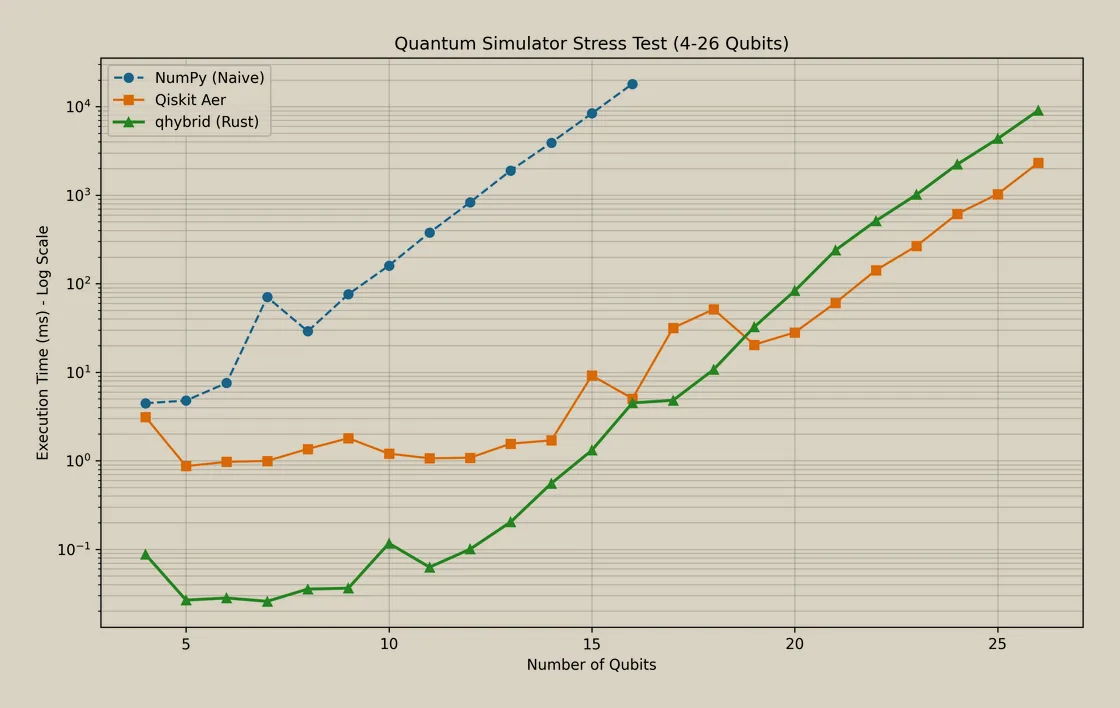
A log-scale chart of execution time against qubit count for NumPy, Qiskit Aer and the Rust simulator. The Rust line starts lowest and crosses above Aer at about 19 qubits.
Fig. 1Execution time from 4 to 26 qubits for a naive NumPy simulator, Qiskit Aer and QuantumForge’s Rust core. Lower is faster. Chart from Ryukijano/quantumforge, one run of the stress test on a local CPU.
Scope

The benchmarks are one CPU machine and random circuits from my own harness. H₂ is the smallest molecular test, so the energy results show correctness, not scale.

Stack
Rust, rayon, Qiskit, VQE, GQE
Links
Code

Also

  • 2026H-cGQE: Conditional GQE
  • 2026iQuHACK 2026 NVIDIA LABS
  • 2025Bradford Quantum Hackathon 2025
  • 2025YQuantum 2025 (Yale)
  • 2025NQCC UK Quantum Hackathon
GitHub· ORCID· Google Scholar· LinkedIn· Hugging Face· X